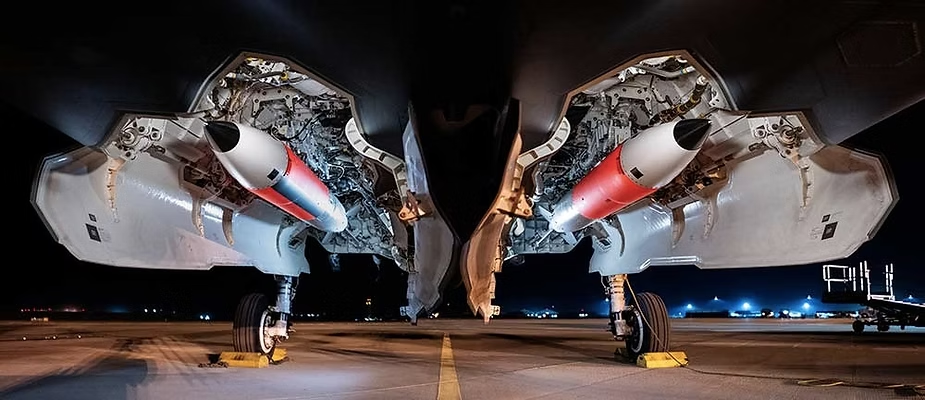
Scientists and engineers from Sandia National Laboratories and the National Nuclear Security Administration (NNSA) have confirmed a series of successful flight tests for the upgraded B61-12 nuclear gravity bomb, dropped for the first time from an F-35A Joint Strike Fighter aircraft. The tests at the Tonopah Test Range in Nevada, reported Sandia National Laboratories, validate the weapon’s end-to-end reliability as it enters a newly extended service life.
Conducted over three days in August, the tests involved dropping inert versions of the bomb, known as joint test assemblies, from the advanced stealth fighter. This milestone was crucial for integrating the B61-12 fully with the F-35, a key platform for the U.S. nuclear deterrent. The success marks a significant step in evaluating the weapon’s performance and the aircraft’s ability to deploy it effectively.
What made this test series particularly groundbreaking was a pioneering procedure: the first-ever thermal preconditioning of a test unit before its flight on an F-35. This process involves exposing the weapon to specific temperature extremes it might encounter during a real mission while attached to the aircraft. According to Sandia National Laboratories, this validated the B61-12’s ability to withstand real-world combined environmental stresses, a critical factor for reliability.
These were the only stockpile flight tests planned for the B61-12 on the F-35, making them the definitive proof point for the system. The collaboration between Sandia stockpile systems, test range staff, and the U.S. Air Force was essential to the operation’s success. This partnership ensures that the weapon system is not just technically sound but also operationally viable for the warfighters who would use it.
READ ALSO: https://www.modernmechanics24.com/post/china-unveils-as700-airship-in-shaoxing
“These B61-12 F-35A stockpile flight tests and captive carry flight test were the capstone accomplishment of a tremendous amount of planning and effort by those who were involved across not only Sandia, but many other agencies,” said Sandia’s Jeffrey Boyd, surveillance lead for the B61-12 and B61-13. He emphasized that this series represented the completion of the most extensive B61-12 flight testing surveillance scope in a single year to date.
The tests also required immense flexibility. Tonopah Test Range Manager Brian Adkins, who oversaw the operations, highlighted the team’s ability to adapt. “Expedient coordination by the entire test team resulted in two successful days of testing to evaluate three test assets,” Adkins noted, underscoring the complex logistics involved in such high-stakes evaluations.
The data gathered from these flights is now being meticulously analyzed. The insights will feed directly into the annual assessments conducted by NNSA laboratories, helping to ensure the continued safety and reliability of the nation’s nuclear stockpile. This work is a core part of Sandia’s mission to advance science and technology in support of national security. The success of these tests comes on the heels of the NNSA completing a multiyear life extension program for the B61-12 in late 2024, which has extended the bomb’s service life by at least 20 years.
WATCH ALSO: https://www.modernmechanics24.com/post/elon-musk-space-internet-ghana